

Narcissism and Echoism
Trauma bonding and co-dependency

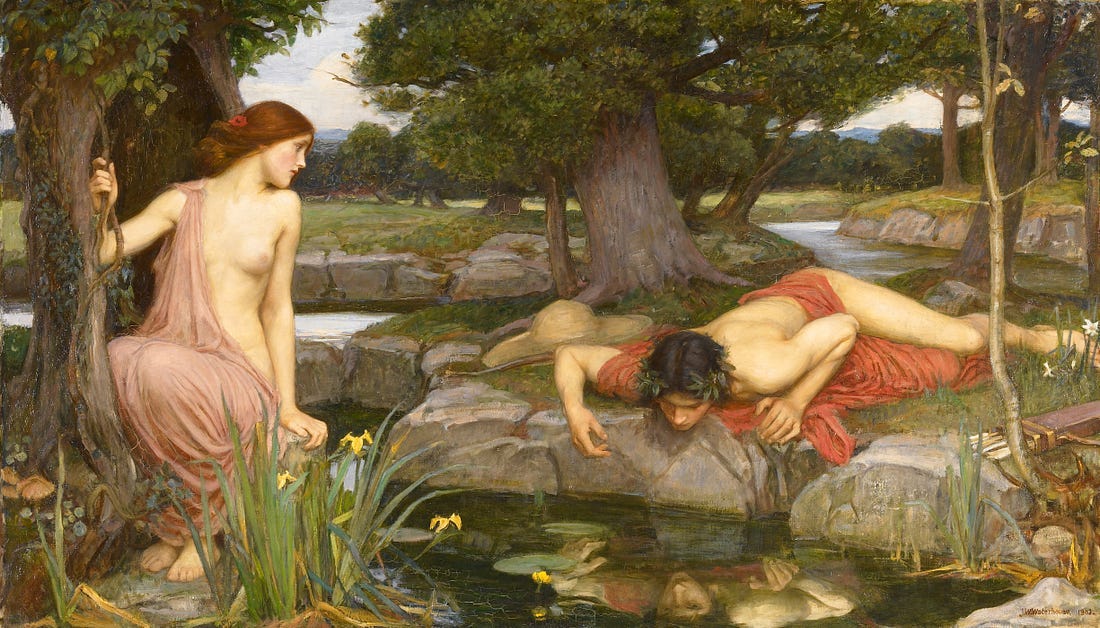
You probably heard of Narcissus, from Greek-Roman mythology, who has given his name to the personality trait Narcissism. But have you heard of Echo? The wood nymph that fell in love with him, but got rejected and withered away of a broken heart? She represents the other side of the Narcissistic spectrum — where you find Echoism.
The original story goes like this:
(There are different versions, but with the same main content.)
Narcissus, a young and very beautiful demigod, is out hunting in the woods. He is very aware of his beauty and has rejected everyone who has fallen in love with him so far; they are not as beautiful as he is; how could he possibly fall in love with any one of them?
Echo, a wood nymph, sees Narcissus in the woods and instantly falls in love with him. Echo has her own tragic background. She has helped Zeus to distract his wife from finding out that he was entertaining himself with wood nymphs. Echo used to chat away with Hera, Zeus’ wife, so the other wood nymphs and Zeus could sneak away from her. When Hera found out, she put a spell on Echo saying that in the future you will never get the first word anymore, only the last. After this, Echo could not speak, only echo the last words someone spoke to her.
Echo followed Narcissus in the woods for a while, not daring to show herself, and each time he called out — Who’s there ?— she could only answer — There! Narcissus at last called out — Come out and meet me! And Echo finally dared to show herself and rushed towards him, arms open to embrace him, saying — Meet me! But appalled by her, he pushed her away saying — I can never love someone like you!
Echo, heartbroken, withdrew into the woods. Nemesis (the goddess who enacts retribution against those who succumb to hubris), hearing this, got upset with Narcissus for his cruel treatment of Echo and punished him by luring him to a pond with very clear water, like a mirror. Narcissus leaned over to drink, saw this beautiful person in the pond, and fell instantly in love — not recognizing it was his own reflection.
He did realize this later — and in most versions of this story, he ends up taking his life in despair over never being able to attain the lover he desires — himself. He dies and the only remains of him are a flower with white petals and a yellow eye — a Narcissus. Echo hears of his death and utters a last echo of his last words to her — Love you! — and then withers away until nothing else but her voice is left as an echo in the woods.
When a Narcissist meets and Echoist
We all know and recognize what a Narcissist is. The person who cannot love someone else, but only the picture he has created of himself, and in everyone else is looking for the perfect reflection of himself. He constantly needs to be reflected back as a grand person, as the better one, smarter one, more beautiful one, with no flaws or imperfections. He is dependent on constant feedback by other people who tell him this, that he is more and better than other people.
The perfect match is when the Narcissist meets an Echoist. An Echoist is drawn to the colorful, strong and self-centered Narcissist. Often an Echoist has grown up with one or both parents being Narcissists (as the Narcissist also often has) and becoming an Echoist is one survival strategy (instead of becoming a Narcissist).
An Echoist becomes the mirror the Narcissist needs. He becomes the voice she lacks and needs. The Echoist celebrates and nurtures the Narcissist’s grandeur. An Echoist does not feel she has any worth on her own, and therefore needs the Narcissist to appreciate her for what she gives to the Narcissist.
In the beginning the relationship works
The Narcissist is charming and feels how he is reflected back as the powerful and mighty person he needs to feel like; the Echoist gives and gives and feels valued for that, and secure in a place by the Narcissist’s side. But it does not take long before the Narcissist starts to get bored with or annoyed by the Echoist.
He becomes more and more demanding; the Echoist must work harder and harder to give the Narcissist what he needs. In the end, the Echoist will drain herself, will start to wither away — she gives more than she has. And there is no way the Echoist can give the Narcissist what he truly wants, since what he wants is not to be found in the Echoist.
The Narcissist cannot receive the love the Echoist can give, cannot afford to show himself vulnerable, must always be the courageous, smart, successful person — and can therefore not show his true self (and therefore not be loved for who he is — not by himself, not by anyone else). The Echoist does not love herself enough to stand up to the Narcissist and call him out.
Both love the Narcissist more than the Echoist
Both are occupied with feeding the need of the Narcissist. Until one day, the Echoist either has withered away so much the Narcissist does not get fed enough and is bored with her and therefore feels he needs a new Echoist, or the Echoist finds it in herself to stand up to the Narcissist and leave, realizing the Narcissist will never see her, never love her, and out of pure self-preservation, leaves the relationship. Both truly suffer from the lack of ability for self-love — but “solve” the lack of it in diametrically different ways.
In a relationship between a Narcissist and Echoist — both are dependent on each other. But it can never lead anywhere, as long as the Narcissist cannot open up, show himself and be vulnerable — the relationship is doomed. An Echoist can stay for a very long time in a relationship with a Narcissist, as long as he does not totally tire of her — and give herself and her needs up completely. Needs the Echoist never has felt are valid and therefore cannot put and take care of before the needs of the Narcissist.
Neither of them can be happy in a relationship with the other
Neither of them feel truly seen or heard. Neither of them feel they get their needs met. The Narcissist will keep on demanding more and more — the Echoist will keep on giving and adapting more and more — and the frustration will grow stronger and stronger within the Narcissist, and the confusion and efforts to self-eradicate will grow stronger and stronger within he Echoist. The Echoist will end up tiptoeing around the Narcissist, trying to read and meet his needs before he erupts. She will live in hypervigilance.
An Echoist, if she regains a feeling of some self-worth, will be able to leave. If she does she has a better chance of a happy life than the Narcissist. If he cannot open up to be a human with vulnerabilities, he will keep on falling in love with the perfect reflection of himself that he sees in others. But will always end up not feeling truly seen, as the other gets to know him better and can see his flaws, which he himself can never accept as belonging to him. But instead will see and put on the other instead.
The Echoist will not only carry her own lack of self-worth, she will slowly carry more and more of the Narcissist’s lack of his self-worth too. This becomes a vicious relational dance where one, to sustain himself, sucks the life out of the other, and the other willingly gives it up to be able to stay in the shadow of the other.
The problem for the Narcissist is that the admiration and submission he requires from the other, he also despises, as it reminds him of his own weakness (his narcissistic wound, his deep and hidden fear that he is inadequate and not enough). The more the Echoist pines for love from the Narcissist — the more he will despise her. The more he will then mistreat her, show his ill-temper and disrespect. This can act as a wake-up call for the Echoist. What remains of the once charming Narcissist is only rage and discontent. She cannot, will not, ever be enough for him.
The Echoist will not only carry her own lack of self-worth, she will slowly carry more and more of the Narcissist’s lack of his self-worth too. This becomes a vicious relational dance
The Narcissist and the Echoist exists on the same spectrum — both are occupied with mending their lack of self-worth, one with dedicating himself to the love of himself, the other with dedicating her love to another. Narcissists are obsessed with themselves and Echoists are obsessed with others. Neither of them will find what they look for in the other. Both need to look inside themselves and learn to love and respect themselves, with all their dark and light, “good” and “bad” sides.
Is it peculiar that we are so obsessed with seeing the Narcissist in people, but do not recognize the Echoist?
We all have both Narcissistic and Echoistic tendencies
Some people score high in one end — and other people score high in the other. They are reflecting the same traits, being on the opposite sides of the same coin. We all need the ability to feel special — but not to crave it all the time. A Narcissist desires it — an Echoist fears it.
Another vicious complication in a Narcissistic-Echoistic relationship is that one of the biggest fears of an Echoist is to seem narcissistic in any way — which a Narcissist will recognize and use by projecting all his Narcissism onto the Echoist. And the role reversal and manipulation can keep on going — as well as the confusion and dependency on each other.
I am gendering the Narcissist him and the Echoist here — but the roles can of course be reversed, or this can play out in a same sex relationship, either of a romantic or a collegial kind, in a friendship, in a mother-child relationship, in a therapeutic relationship, or in any other kind of relationship.
Adding in a later update - about therapy
This is unfortunately not too uncommon to play out in a therapeutic relationship. I don’t know what to think about if therapists tend to be more narcissistically inclined than other people. But a therapy setting with its almost always built-in power imbalances, more easily invite this kind of power dynamics. So if you have been hurt and/or harmed in therapy, or work as a therapist, read the text, and have a therapeutic relationship in mind. As we most often think about a romantic relationship when we think of these kinds of relational dynamics. It can be an eye opener to switch focus. It was to me.
I can add that the first time I posted this text on my blog, my then therapist got very angry with me, for the second time in a week. I wrote this after she had cancelled my intensive therapy days I used to go to her for. Which meant I lost the money I had paid for flight and train tickets. She cancelled me just a few days before I was supposed to be going. Over a tiny mistake I had made (and porously apologized for), but it wasn’t enough for her and she punished me by cancelling the therapy. You could think that would be the end of that relationship. It wasn’t, I was too stuck in it that I could not think clearly. It would take me yet four more years to end it, by that time it had morphed into a business relationship.
Was I an echoist? Absolutely. I do not tend to be that, but this relationship called forth forces aligning with what I had grown up with, and I went into survival mode and lost all my bearings.
References:
Narcissus and Echo Myth: Understanding Narcissism and Echoism Today
Narcissus and Echo: The Myth and Tragedy of Relationships with Narcissists
You Aren’t a Narcissist, But Could You Be an Echoist?
Malkin, Craig (2016) Rethinking Narcissism: The Secret to Recognizing and Coping with Narcissists
Malkin, Craig Seven Signs of Echoism:
Savery, Donna Christina (2018). Echoism: The Silenced Response to Narcissism
I originally published this text at https://livethechange.se in 2020. Apart from the last part about therapy.